

Last week we announced that Parasail will deploy 5 megawatts of Positron AI’s Titan inference systems, coming online in late 2027. We’ve been a customer of Positron’s Atlas systems, which serve cost-efficient tokens at a highly consistent latency, and their next-generation Titan represents a step change in cost-efficient tokens. In this post, I will walk through how I think about the role of a diverse hardware fleet and why I’m excited by Titan, because it says a lot about where inference is heading.
The models our customers run are getting enormous. Even the fast, cheap “flash” tier now runs on mixture-of-experts (MoE) designs with huge total parameter counts that pack similar capabilities as GPT6 and Opus5. The sub-100-billion-parameter era looks questionable in datacenter settings as hardware improvements drive efficiency and MoE models show their strength.
The largest models run out of memory first.
A MoE model splits its weights into many experts and runs only a few of them for each token. For example, Kimi K2 uses 32 billion of its roughly 1 trillion parameters per token, so each token takes a small fraction of the computation a dense model that size would need. The catch is memory. Every expert has to stay loaded in GPU memory, because the model only picks which experts to run when each token arrives.
Then there’s context. An agent working for hours builds up a long history. The model stores its attention state for that history in the KV cache, which lives in the same memory as the weights. On a GPU, the weights and the KV cache share a fixed amount of high-bandwidth memory (HBM). HBM is expensive, power-hungry and supply-constrained, and it depends on advanced packaging that is just as scarce.
So the largest models end up limited by how much memory you can afford to put next to the compute, not by the compute itself. As Positron’s CEO Mitesh Agrawal puts it, “Agents need the largest models, and running the largest models is a memory problem.”
Moving the largest models out of HBM without giving up speed
Titan holds multi-trillion-parameter models in LPDDR5X, a low-power commodity DRAM, in place of the HBM that GPUs rely on. That gives each system terabytes of memory the model can reach directly.
Switching from HBM to commodity memory has some obvious advantages: lower cost per gigabyte, lower power draw, and more stable supply chains. Cheaper memory means more capacity per system, lower power means more compute per megawatt, and a commodity supply chain makes massive scale-up of these systems far easier.
Capacity alone isn’t enough, though. Plenty of systems have had big, slow memory. What makes Positron’s architecture interesting is how they pair DRAM for capacity with fast on-chip SRAM for speed. The art of computer architecture and clever orchestration of activation and weight movement is not dead, and Positron pulled together an impressive set of innovations to make this possible. I’ve been sworn to secrecy on the details, but I can confidently say you probably won’t see a similar set of capabilities elsewhere for quite a while.
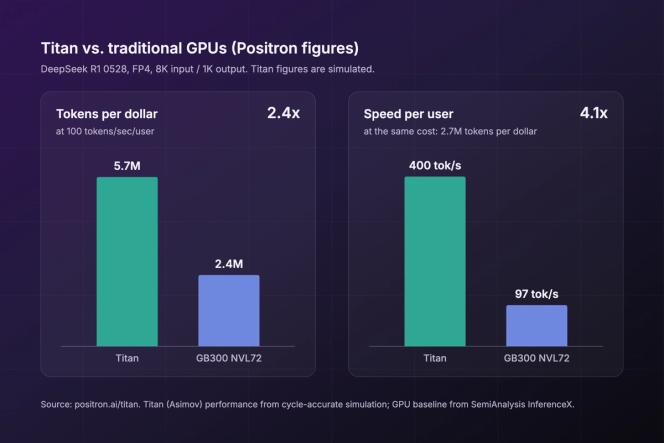
Done right, this memory combination gives you both capacity and speed. Positron puts Titan at 2.4x the tokens per dollar of traditional GPUs, or 4.1x the speed at the same cost per token, based on cycle-accurate simulations against GPU data from SemiAnalysis InferenceX.
What Groq taught me
I worked on non-GPU silicon at Mythic and then at Groq. At Groq I saw firsthand that there is a real market for extremely fast tokens. People will pay for speed when a person is waiting on the answer.
That experience also taught me that speed is only half the picture. The other half is cost efficiency, and it matters more every month, because most tokens are no longer read by a person as they are generated. They are consumed by agents running in highly parallel swarms solving incredibly hard technical challenges, or running silently in the background across enterprises. For these types of agents, the price per token sets the scale, and radically improving price per token pushes the frontier of what’s possible in this agent space. Titan is aimed squarely at this tranche of token demand, and it’s shaping up to be a trillion-dollar segment all on its own.
What more memory makes possible
A large amount of memory does more than fit the largest models. Once the weights are loaded, Titan’s remaining capacity can hold the context and cache that agents build up as they work, which makes several agent workloads practical to run.
- Long-running agents: With enough memory, an agent’s history stays cached between steps, so each new step reuses it instead of recomputing it.
- Agent swarms: Many agents working on the same codebase or document set start from the same prefix. When the KV cache for that prefix stays in memory, every agent reuses it, and the shared work is paid for once.
- Multi-million-token context: As context windows on open models keep growing, multi-million-token contexts will become routine. These contexts are only practical if holding that state is cheap.
Titan’s low power draw also opens up deployments outside the big data center. Physical AI and robotics workloads will need inference close to the machines they run, often where power is limited. That’s a future expansion for us, which we’d build alongside partners running fast CDN and edge networks.
One API, a multi-silicon fleet behind it
No single chip is best at every AI workload, so building around just one never made sense. Interactive traffic needs speed, while agent traffic needs memory capacity and cost efficiency. That’s why Parasail is building a multi-silicon inference cloud that routes each request to the chip that fits it best.
We have silicon partners whose strength is raw speed. Our established GPU fleet runs the widest range of open-weight models, including new releases on day 0. Adding Titan gives us a place to route agent workloads that run the largest models and need memory capacity at the lowest cost per token.
The rule for Titan is simple. Anything that isn’t interactive, anything that doesn’t need an instant response, is a candidate. A chat reply a person is waiting on goes to the fastest silicon. The fortieth step of an overnight agent run goes to the silicon where tokens are cheapest. Models that only run on GPUs stay on the GPU fleet. Customers don’t see any of this. They use the same Parasail account and the same OpenAI-compatible API, and the placement decision is ours to get right.
Commit to tokens, and we’ll orchestrate the hardware
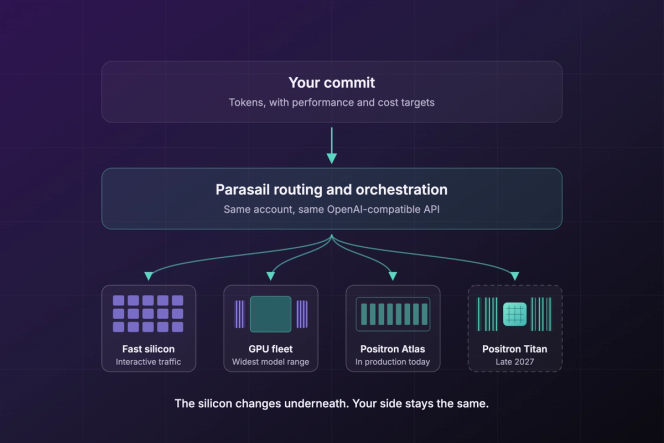
Routing every request to the right silicon is what lets customers commit to tokens instead of hardware. A Parasail commit is a dollar amount of inference with performance and cost targets attached. We decide which silicon serves each request and handle the tuning that keeps it within those targets.
That keeps the customer’s side stable while the silicon underneath keeps improving. When new silicon like Titan joins the fleet, those targets get easier to hit and nobody has to replatform.
I think this is how inference will be bought. In a few years nobody will ask which chip served their tokens, any more than they ask which disk holds their files. They’ll ask what the tokens cost, how fast they arrived, and whether the largest models were available.
Thanks to Mitesh and the Positron team. We expect our Titan capacity to serve trillions of tokens a day for companies building on frontier-scale open-weight models, and I can’t wait to turn it on.


