

Frontier lab APIs represent the current ceiling of public model performance for complex reasoning and long-horizon tasks. But, closed model dependency is becoming a structural liability, and the Claude Fable 5 recall has engineering leaders reconsidering their options.
Here’s the decision framework for creating a reliable inference architecture.
Anthropic’s Fable 5 recall made the architecture risk real
Up until now, the performance argument for building on frontier APIs has been enough to ignore the hypothetical supply-chain risks. But in June 2026 those risks materialized when Anthropic issued a recall of their Fable 5 and Mythos 5 models just a few days after launch to comply with a government directive.
Suddenly the risk of building core business logic on an asset you don't own, can't inspect, and can't protect from third-party intervention became tangible. The reaction from engineering leaders on X shows the shift happening in real time:
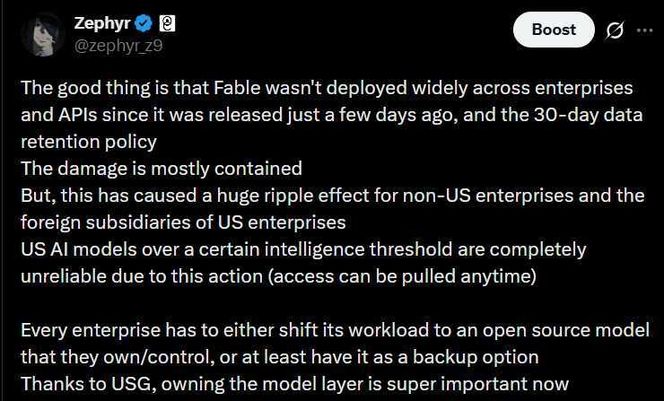
If a regulatory decision, vendor's risk posture, or sudden model deprecation can take your application offline overnight, your AI inference architecture is on shaky ground. De-risking your stack requires a clear-eyed evaluation of what the options are and the tradeoffs you’re choosing between.
This post covers the four primary ways to run inference today: closed frontier APIs, managed inference, self-hosted cloud VPCs, and on-premise bare metal. Then it prioritizes criteria that matter for engineering strategy: data sovereignty, uptime and reliability, model capability, total cost of ownership, and operational complexity.
Scoping your inference architecture
Scoping your inference architecture requires teams to weigh five different variables. While the criteria matter for everyone, what takes priority differs. A compliance-bound enterprise evaluates data sovereignty first. A team migrating off a frontier API is concerned with maintaining model capability. An early-stage startup is bound by cost.
Five dimensions shape where on the inference spectrum any team can operate:
1. Data sovereignty & compliance → What data touches the inference layer, and what geographic residency, data-retention, and contractual requirements apply to it? If the architecture violates GDPR, HIPAA, or your customers' MSAs, nothing else about the decision matters
2. Uptime & service reliability → Does your product require always-on availability, consistent low-latency responses, or can it tolerate cold starts and occasional gaps? Then you need to factor in that regulatory de-platforming, model deprecation, and limited GPU availability can stall your product and pipelines mid-flight.
3. Model selection & capabilities → What is the minimum accuracy and capability threshold your workload requires, while still meeting your product's quality and latency SLAs? Most teams overestimate how much model capability their workload actually needs, which keeps them locked into frontier APIs at frontier prices.
4. Total cost of ownership → What does it cost to start and what does it cost at scale? For example, frontier APIs require almost no setup but become brutal at volume while on-premises demands heavy upfront CapEx but can be very cost effective at scale.
5. Operational MLOps capability → Does your team have the MLOps bandwidth to own the serving stack, or will infrastructure maintenance displace product development? Owning the stack offers control, but for smaller organizations the complexity of managing the stack takes engineering away from the product itself.
The table below maps how these dimensions compare across the five established ways to run production inference.
Five ways to run inference
There are five paths that companies can choose to run their production inference. The options range from outsourced inference where the provider handles hardware, serving, optimization, and model lifecycle, to owned inference where your team controls every layer.
| Infrastructure Path | Data Sovereignty | Uptime & Reliability | Model Capability | TCO | Operational Complexity |
|---|---|---|---|---|---|
| Frontier APIs |
Low No data residency controls. Zero Data Retention guarantees can be revised without notice. |
Medium Strong uptime, but subject to model deprecation, drift, and API rate limits. |
High Highest reasoning capability available. No fine-tuning support. |
High Low startup cost, but per-token pricing becomes expensive at scale. |
Low Provider manages all infrastructure. |
| Managed Inference |
Medium Moderate control. Load balancing may route requests across regions. |
High Provider-managed SLAs, redundant routing, and no throttling. |
High Supports open-weight and proprietary models, including fine-tunes and custom weights. |
Medium Minimum monthly spend with usage-based token pricing. |
Low Provider manages serving, MLOps, and hardware lifecycle. |
| NeoClouds |
Medium Moderate control, but pooled GPU inventory limits visibility into where workloads execute. |
Low GPU availability fluctuates and large models can experience 40-minute cold starts. |
High Any open or proprietary model architecture supported by your GPU tier. |
Medium No upfront investment, but GPU pricing is roughly 2× raw infrastructure costs. |
Medium Your team manages cold starts, scaling, and capacity limitations. |
| Hyperscalers |
High Full control within your VPC. Data never leaves your cloud boundary. |
High Large GPU inventory with consistently available capacity. |
High Any architecture, quantization, or fine-tuning your team can build. |
High High reservation costs and among the industry's most expensive GPU pricing. |
High Your team owns serving, autoscaling, CUDA updates, and inference optimization. |
| On-Premises |
Absolute Total physical control with no third-party infrastructure or runtime access. |
Low Hardware failures require spare capacity and a dedicated 24/7 engineering team. |
High Fully unconstrained. Supports custom architectures, fine-tuning, and silicon-level optimization. |
High Significant CapEx plus ongoing power, cooling, maintenance, and staffing costs. |
High Your team owns hardware, networking, cooling, power, and the complete software stack. |
Frontier APIs
Examples: OpenAI GPT-4o/GPT-5, Google Gemini Ultra, Anthropic Claude API
With frontier APIs, you consume top-tier intelligence as a black-box utility, offloading all memory layout optimization, token batching mechanics, and model alignment to the frontier lab with no guarantees.
Frontier models offer the highest ceiling for raw reasoning and multi-step agent execution currently available, and operational complexity is effectively zero. For prototyping and early releases, nothing gets you to a working product faster.
Data sovereignty is where it starts to break down. Your data crosses third-party infrastructure with no visibility into residency or retention, which disqualifies this option for any workload subject to GDPR, HIPAA, or strict customer MSAs.
Frontier labs are also known to retire models without notice, silently update how the model behaves, and hit you with rate limits when traffic spikes. Fine-tuning and custom deployments are out of the question (unless you have enough capital to convince them otherwise.)
On cost, pricing looks manageable early on, but this is the option that scales worst. At meaningful volume, you're paying a premium for intelligence you can't inspect, on infrastructure you don't control.
Verdict: Frontier APIs suit early-stage MVPs, internal productivity utilities, and highly complex, low-volume reasoning tasks where the application can tolerate short-term migration risks or sudden API modifications.
Managed inference
Examples: Parasail, Together AI, Fireworks.ai, Baseten
You host open-weight models, or your own proprietary weights, on third-party managed inference infrastructure.
Model selection is unconstrained. Host any open-weight architecture such as Kimi K2.6, GLM 5.2, or DeepSeek V4 Pro, or deploy custom fine-tunes and proprietary weights. You get production-grade token throughput without hardware procurement delays, offering built-in redundancy because the underlying model weights can be re-routed if a provider goes down.
Data sovereignty is the variable to watch. Load balancing routes requests across regions, which means your data can cross borders without your knowledge. On the reliability side, multi-tenant traffic spikes (a.k.a. the Noisy Neighbors problem) can degrade latency and throughput unpredictably.
Parasail’s Elastic Endpoints address both these challenges by combining per-token billing with a private, single-tenant endpoint, locking in latency and residency SLAs without paying for idle GPU time.
Verdict: Managed inference is ideal for high-growth software applications that require low latency and competitive volume pricing, but do not handle deeply locked-down data that strictly bars third-party transit.
Neoclouds
Examples: RunPod, Vast.ai, Salad, Vultr
Smaller GPU cloud operators that offer raw compute access, often at lower headline rates than major hyperscalers, with serverless deployment options that spin up GPU capacity on demand.
The economics work well at low and sporadic usage. When a request comes in, the provider wakes a GPU, loads your model, serves the request, and bills by the second. When traffic drops below a configurable idle threshold (typically 1-2 minutes), the machine shuts down and billing stops. Model selection is also unconstrained: run any open-weight architecture your GPU tier can support.
Reliability is the structural flaw. GPU inventory on neoclouds is limited and fluctuates hour-to-hour with no way to guarantee availability. When your endpoint tries to scale during a demand spike and inventory isn't there, requests fail. The moment you need more capacity is the moment the supply isn't there.
On cost, the headline rate is lower than hyperscalers, but the math is less favorable than it looks. The idle timeout means you're billed for up to two minutes after every request, and the serverless markup runs about 2x the raw GPU rate. If your traffic is consistent enough to keep machines awake, you're better off on a dedicated endpoint.
Data sovereignty is also murky. Many neoclouds pool inventory across networks of smaller operators. RunPod's "community servers" are capacity sourced from third parties, not RunPod's own hardware. You can't always tell exactly where your workload is running.
Verdict: Neoclouds suit individuals or AI hobbyists with sporadic, experimental, or time-bounded workloads where availability variability is acceptable and the low upfront cost matters more than reliability guarantees. They're not a production inference platform for scaling teams.
Hyperscalers
Examples: Deploying open architectures via vLLM or TensorRT-LLM frameworks on AWS EKS, OCI, or Google Cloud or neoclouds like Runpod or Vast.ai
You provision cloud-based accelerated compute (NVIDIA H100/B200 tiers) directly within your secure virtual private cloud, running open-weight models via frameworks like vLLM or TensorRT-LLM.
Data sovereignty is airtight. Your data never leaves your VPC, and you have full control over the execution environment. You can run any architecture, fine-tune, quantization, or speculative decoding setup your team can build. Reliability from an availability standpoint is strong: major hyperscalers have deep GPU inventory. If you're willing to pay for it.
Cost is where things get painful. Not only is GPU capacity on major hyperscalers expensive to begin with (an H100 SXM on AWS runs $6.88/hr on-demand), but GPU-hour billing makes TCO volatile. If traffic dips and hardware utilization drops, your cost per million tokens
Your team also inherits the full MLOps stack including attention backends, cold-start management, CUDA updates, autoscaling.
Verdict: VPC self-hosting is the optimal production standard for mature enterprises handling proprietary data within strict compliance boundaries, provided they have a dedicated MLOps team and stable, high-volume traffic to offset dedicated GPU costs.
On-premises local hosting
Examples: Private rack-scale architectures, custom Supermicro or NVIDIA bare-metal server clusters.
You purchase or lease physical enterprise silicon in your own data center. Nothing touches infrastructure you don't own.
It offers absolute, irrevocable data sovereignty and complete immunity from third-party runtime interventions or cloud provider system modifications.
However, model capabilities are hardware-bound by your VRAM pool. The architecture is exceptionally rigid due to lengthy procurement cycles. When a GPU fails, you're either taking production down to RMA with the vendor, or you buy more capacity than you need as a buffer.
On top of that, upfront CapEx is massive and electricity at GPU cluster scale is an ongoing cost most teams underestimate.
Verdict: On-premises local hosting should be strictly reserved for national defense applications, air-gapped financial transaction networks, and heavily regulated healthcare institutions bound by physical data-residency mandates.
Why managed inference is the right call for most scaling teams
If Fable 5 changed your risk calculus on frontier APIs, and you don’t have the team or the timeline to absorb the MLOps burden of maintaining the stack yourself, managed inference is the sweet spot for most scaling teams.
You get production-grade reliability without the engineering overhead of owning the infrastructure.
Parasail does managed inference differently. Here's how we approach each of the five criteria for architecting inference:
Enforceable data sovereignty. Parasail operates 40 data centers across 15 global regions, largely outside the major hyperscaler footprint. On Dedicated and Elastic Endpoints, teams can contractually bind inference workloads to specific geographic regions.
Fluid uptime and reliability. Parasail decouples product uptime from individual server nodes by routing traffic across a shared capacity pool. When a dedicated node stumbles or traffic spikes, our orchestration layer redirects GPU capacity from background workloads to cover production traffic immediately.
Unconstrained model capability. No catalogue constraints on what you can run. Custom fine-tunes, domain-specific weights, and multi-model pipelines all run on the same contract, and you can swap architectures the day a new model drops without renegotiating anything.
Flexible inference commits. Traditional dedicated inference commits lock you to a GPU generation or model architecture. Parasail commits are denominated in token spend: overages bill at your standard rate, unused spend rolls over, and if you scale faster than planned you can true-up mid-contract.
Performance engineering access. Our team handles attention backends, CUDA updates, and kernel tuning across a multi-generational GPU fleet. Every optimization, including speculative decoding and any lossy quantization, is disclosed and tested by your team before it ships.
Start building with Parasail
If you're thinking about decoupling from closed-source APIs, or your self-hosted prototype is costing more in engineering time than it saves in tokens, Parasail can have your endpoint up and running in hours, with geography controls, private model support, and usage-based inference pricing.


